Crossing
AlUla, Saudi Arabia: A Desert That Doesn't Feel Real
Hegra's 2,000-year-old Nabataean tombs, desert horseback rides, and a night under the stars at Desert X — a first-hand guide to AlUla.
Pamela Sarti · · 9 min read

I genuinely don't know how to explain AlUla properly, so let me warn you up front: I have about a million things to tell you, I'm going to try to fit them into one diary entry, and I'm going to fail. Some places are bigger than the words you have for them.
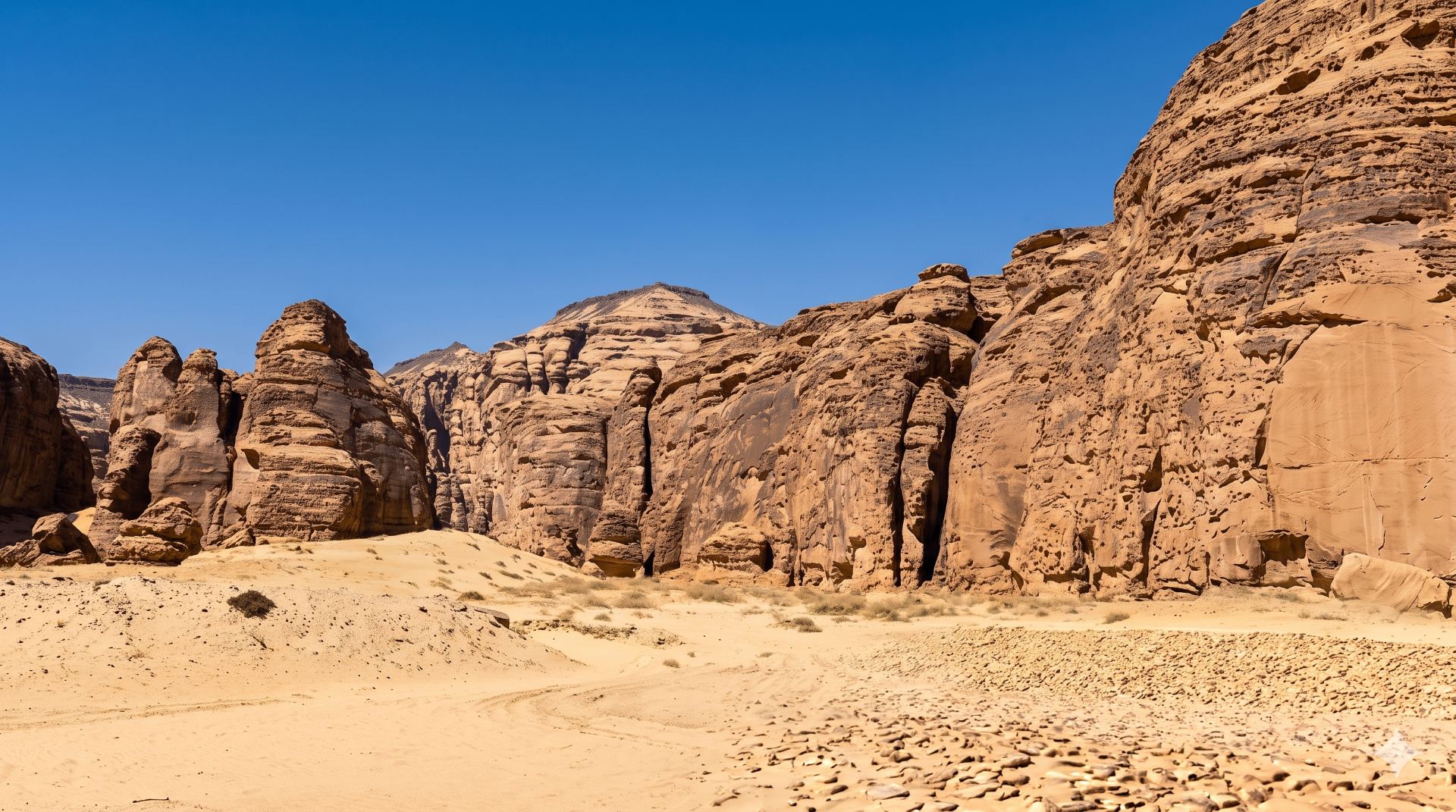
It's a desert paradise — endless golden sand, and then rising out of it, huge sandstone formations. And then, scattered among all that ancient stone, there are green things growing. Real plantations. I'll get to that. I promise — it's one of the strangest, best parts.
How to get to AlUla — and the e-visa, simply
AlUla sits in northwest Saudi Arabia, about 330 km northwest of Medina by road. There's now an AlUla International Airport (ULH) — direct from Dubai and Doha, and domestic flights from Riyadh, Jeddah, and Dammam. Carriers include Saudia, flynas, flydubai, and Qatar Airways. It's a ~25-minute drive from the airport into town. If you want to combine AlUla with the holy city of Medina, the usual way is to drive — it's about a four-hour road trip, and a popular pairing.
Visa: Saudi Arabia opened up to tourism in 2019 and now offers a tourist e-visa you can apply for online via the official Visit Saudi site, typically valid for one year with stays up to 90 days. Crucially, cost and eligibility vary a lot by nationality and by how you enter — some travellers pay a fee, others (or those entering on certain existing visas) pay little or nothing, and GCC nationals don't need one at all. So don't budget a fixed number — just check the official portal for your own situation before you go. Rent a car too — the sights are spread across the valley.

Hegra: standing before 2,000-year-old Nabataean tombs with nobody around
The crown jewel is Hegra (Mada'in Salih) — Saudi Arabia's first-ever UNESCO World Heritage Site, and the largest preserved city of the Nabataean civilisation south of Petra. Same astonishing carving tradition as Petra in Jordan — but quiet enough to stand alone before a tomb and hear the wind.

You walk up to a sheer rock face and there's a perfect carved doorway, columns, an eagle, weathered inscriptions — two thousand years old, crisp as if the carver stepped away yesterday. Beyond Hegra there's the ancient kingdom of Dadan and Jabal Ikmah, an open-air "library" of inscriptions in languages from a vanished world. I stood there unable to process that humans did this, by hand, twenty centuries ago.

A horseback ride through ancient cities — and plantations in the sand
We went on a horseback ride — AlUla runs beautiful guided rides on gentle, beginner-friendly trails, the kind you can do even if you've barely sat on a horse before. You ride the way the ancient inhabitants once did, past the sandstone formations and the edges of old settlements.


And here's what got me. The whole of AlUla sits in the middle of the desert — and then, mid-ride, we came across the structures of an ancient city with plantations growing right there among them. Real, green, growing crops, in the middle of all that sand and stone. I just sat there on my horse staring at it, because it makes no sense and total sense at once: thousands of years of history, brutal arid land, and people still coaxing food out of it, fed by the same water that made this a stop on the ancient trade routes. That contradiction is AlUla. Nothing here is what you expect.
Desert X AlUla: the night in the desert I'll never get over
We went to Desert X AlUla — an open-air art exhibition spread out across the desert, with land-art installations set right into the canyons and sand. Honestly? At first I didn't quite know what to make of it. But then they brought out a storyteller sharing the region's old tales, and an astronomer to walk us through the constellations — and the whole thing clicked into something I wasn't expecting to feel.

Full dark, no city light for miles, the desert cold settling in, and someone who's studied this sky their whole life pointing up — naming constellations, telling you which stars the caravans steered by, the same stars over the same sand. History and sky, stitched together above your head. I've watched a lot of stars in a lot of countries. This one undid me.
(AlUla's modern landmark, by the way, is Maraya — recognised by Guinness World Records as the world's largest mirror-clad building, a concert hall wrapped in roughly 9,740 m² of mirrors, set into a canyon so it nearly disappears into the desert. Worth seeing for the sheer audacity.)

Visiting AlUla during Ramadan, and as a woman

We visited during Ramadan, and it shaped the trip — for the better. By day, eating, drinking and smoking in public isn't done (it's prohibited by law for everyone), and many restaurants stay closed until after sunset. But the evening transformation is magic: once the fast breaks at iftar, everything turns social and festive and generous.
And the people were so warm. Everyone seemed more open, more tender — and as a woman I was met with genuine, almost protective kindness everywhere. Saudi Arabia is increasingly reported as a safe destination for solo female travellers, and my own experience matched that completely — but honestly, no index told me as much as the daily kindness of the people I met did.
For women travelling here: dress modestly, especially during Ramadan — cover shoulders, knees and midriff; loose, lightweight clothing is ideal for the heat and respectful. The abaya is no longer legally required for non-Muslim women, but it's a nice gesture at times. A headscarf isn't needed for everyday sightseeing, but cover fully (head included) to enter a mosque. Dressing modestly felt less like a rule and more like meeting people halfway — and they met me right back.
Come in the cooler months — roughly October through April (a pleasant 15–30°C). Summer here is brutal; don't fight it.

Why AlUla should be your next trip
Here's what I'd lean in and tell you: AlUla is one of those places the world is only just discovering — and you can feel that you're early. You get Petra-level wonder at Hegra without the Petra-level crowds. You ride a horse past two-thousand-year-old tombs and stare at plantations growing in the sand. You get a desert night so quiet and so full of stars that an astronomer can hand you the whole sky. And the welcome — especially, in my experience, as a woman — is warm enough to make you want to come back before you've even left. Getting there is genuinely easy now: an online e-visa, a short flight, a rental car. I left with a million stories and the certainty I'd only scratched the surface — which is the best feeling a trip can give you.
Read next
Frequently asked questions
How do you get to AlUla, Saudi Arabia?
Fly into AlUla International Airport (ULH) — directly from Dubai and Doha, or domestically from Riyadh, Jeddah and Dammam (Saudia, flynas, flydubai, Qatar Airways). It's ~25 minutes by road to town. You can also drive from Medina in about four hours.
Is Hegra worth visiting?
Yes — Hegra is Saudi Arabia's first UNESCO World Heritage Site and the largest preserved Nabataean city south of Petra, with 111 rock-cut tombs from the 1st century BC to 1st century AD, and far fewer crowds than Petra.
Do you need a visa to visit Saudi Arabia as a tourist?
Most tourists apply for a Saudi tourist e-visa online via the official Visit Saudi portal, typically valid one year with 90-day stays. Cost and eligibility vary by nationality and entry type, so check the official portal for your case.
What's the best time to visit AlUla?
October through April, when daytime temperatures are a pleasant ~15–30°C. Summers are extremely hot.
Is AlUla safe for solo female travellers?
It's widely reported as safe and welcoming. Dress modestly (shoulders, knees, midriff covered); an abaya isn't legally required, but full cover including a headscarf is needed to enter a mosque.
Pamela Sarti writes for Trovr about places, gear, and the philosophy of immersive travel.